
On This Page
Healthcare innovation depends on the organizations delivering care. New diagnostics, digital tools, and clinical services need providers who can evaluate them, put them into practice, and use them effectively over time. The financial pressures facing these organizations can have a significant impact on how quickly new healthcare solutions reach patients.
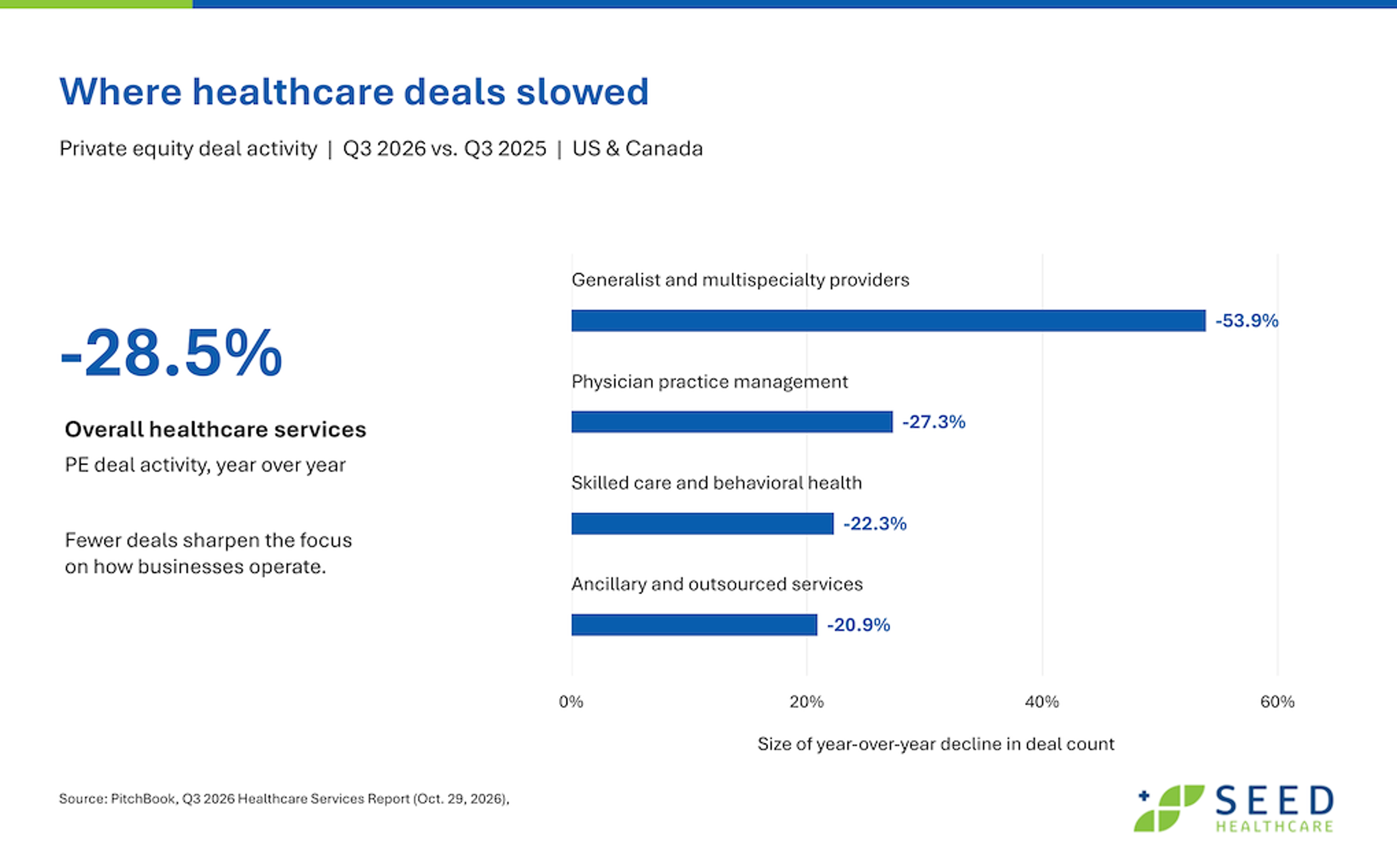
PitchBook’s Q3 2026 Healthcare Services Report highlights a challenging environment for private equity investment in healthcare services across the United States and Canada. Deal activity fell 28.5% compared with the third quarter of 2025, with declines across all four major healthcare services segments.
While the report focuses on private equity investment in healthcare services, its findings also offer useful insights for healthcare innovators, providers, and investors working to bring new technologies to market.
For Seed Healthcare, the takeaway is clear: successful healthcare innovation requires strong clinical evidence, a sustainable business model, and a practical plan for bringing new solutions into everyday care.
Healthcare Investment Slows Across Major Sectors
The decline in investment activity affected several areas of healthcare. According to PitchBook, third-quarter deal counts fell year over year across four major segments:
- Generalist and multispecialty providers: Down 53.9%
- Physician practice management: Down 27.3%
- Skilled care and behavioral health: Down 22.3%
- Ancillary and outsourced services: Down 20.9%
 View full-size image
Despite the overall slowdown, major transactions continued. The quarter's largest deal was the $7 billion buyout of specialty pharmacy PANTHERx Rare, which helped support total transaction value even as the number of deals declined.
These trends show why it's important to look closely at individual opportunities. Healthcare businesses face different challenges depending on their services, reimbursement models, staffing needs, and growth potential.
For investors and founders, understanding these differences can help identify where demand remains strong and where new solutions have the best chance of succeeding.
Healthcare Sectors Continue to Show Strength
Despite the broader slowdown, certain healthcare sectors have continued to attract investment.
PitchBook found that diagnostic laboratory deal activity during the first nine months of 2026 had already surpassed the total for all of 2025. Imaging and ambulatory surgery centers also showed relative strength.
Within physician practice management, vision, fertility, and gastroenterology were on pace to exceed their 2025 deal counts.
These areas may offer promising opportunities for healthcare companies and investors. However, each opportunity still needs to be evaluated based on its clinical value, customer demand, and financial potential.
For example, a diagnostic company needs to demonstrate how its technology can help physicians make better decisions and how it fits into existing clinical workflows. Similarly, an outpatient healthcare solution needs a clear implementation plan, an appropriate patient population, and a realistic path to payment.
The strongest opportunities are those that address a specific healthcare need and give providers a practical way to adopt the solution.
Longer Investment Holding Periods Increase the Focus on Operations
Another important finding from the report is that private equity firms are holding healthcare investments longer.
PitchBook reports that the number of PE-backed healthcare services companies held for at least five years, excluding add-on investments, increased from 568 in the second quarter to 628 in the third quarter. The share of companies held for more than eight years also reached a record 7.1%.
Longer holding periods can create additional pressure on investors and healthcare organizations to improve performance and manage costs over time.
For healthcare providers, this means taking a closer look at staffing, technology investments, and how efficiently care is delivered. For investors, it means understanding how a business can grow and improve its financial performance throughout the investment period.
Healthcare technology companies should also consider these pressures when approaching potential customers. Providers need to understand the cost of implementing a new solution, the resources it will require, and the benefits they can expect.
A clear plan with realistic costs, timelines, and measurable results can make it easier for healthcare organizations to move forward with new technology.
Regulatory Changes Add to Investment Considerations
Regulatory scrutiny of private equity involvement in physician practices continues to create uncertainty for healthcare investors and operators.
As regulations evolve, healthcare organizations need to pay close attention to ownership structures, clinical oversight, and how business decisions affect patient care.
For investors and providers, this includes understanding who is responsible for clinical decisions, how care will be maintained, and how the organization would respond to changes in regulatory requirements.
Healthcare technology companies also need to understand how these factors affect purchasing decisions. Knowing who approves new technology, who oversees its clinical use, and who manages implementation can help companies navigate the sales process and build stronger provider relationships.
Addressing these questions early can help reduce delays and support smoother adoption.
AI and Automation Offer Opportunities to Improve Efficiency
PitchBook also highlights the potential for AI-driven automation to improve financial performance in physician practice management.
Healthcare organizations are increasingly exploring ways to automate administrative work, reduce costs, and give staff more time to focus on patient care.
The value of these tools depends on how well they work within an organization's existing operations.
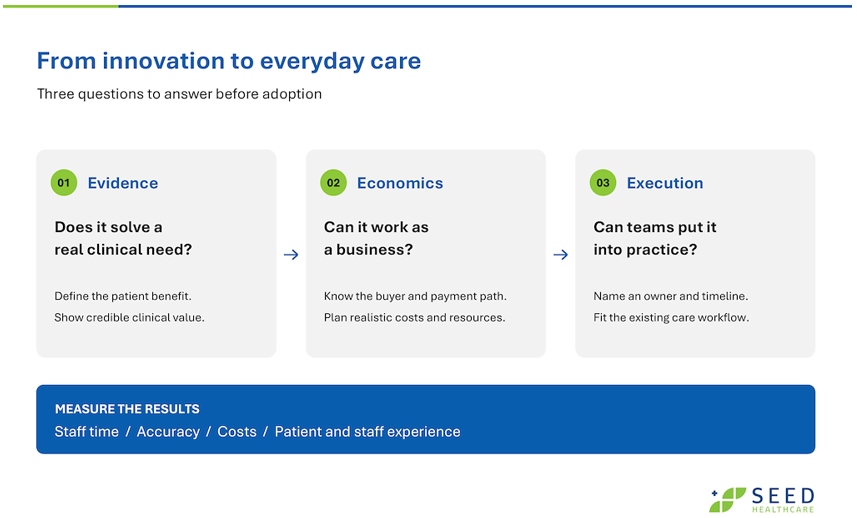
For example, when evaluating an automation tool, providers should consider which tasks it will improve, how much staff time it could save, and what training or technology integration will be required.
They also need a way to measure results, including time savings, accuracy, costs, and the effect on patient and staff experiences.
For founders, demonstrating these benefits can help build a stronger case for adoption. For investors, measurable improvements in efficiency and financial performance can help determine whether a technology has long-term growth potential.
 View full-size image
What This Means for Providers, Founders, and Investors
The current investment environment reinforces the importance of making thoughtful decisions about where to invest time, capital, and resources.
For healthcare providers: Focus on solutions that address clear clinical or operational needs. Understand the resources required to implement new technology, identify who will lead the process, and establish how success will be measured.
For healthcare founders: Build a clear path to commercialization. Understand who makes purchasing decisions, how customers will pay for the solution, and what needs to happen before a provider can adopt it. Set realistic timelines and demonstrate the value your technology can deliver.
For investors: Look closely at clinical evidence, customer adoption, operating costs, and growth potential. Consider how a company will perform under different market conditions and whether its business model can support long-term growth.
Although PitchBook's report focuses on private equity investment in healthcare services, these considerations are also valuable when evaluating emerging healthcare technologies.
Turning Healthcare Innovation Into Real-World Impact
At Seed Healthcare, we focus on connecting capital, healthcare expertise, and strategic relationships to help innovative companies bring their solutions into practice. Our emphasis on early disease detection and prevention reflects our belief that identifying health risks sooner and giving providers the tools to act can lead to better outcomes.
As healthcare investment becomes more selective, companies with strong clinical value, clear commercial strategies, and the ability to execute will be better positioned to grow and make a meaningful impact on patient care.
Source: PitchBook, Q3 2026 Healthcare Services Report: Headwinds Persist With More Hot Air Out of Washington, Brian Wright, with data analysis by Adi George, published October 29, 2026. Market data cover the United States and Canada as of September 30, 2026.