
On This Page
Part 1 of 3: Making Prevention Work in Everyday Care
What does it take to move healthcare from treating disease to preventing it?
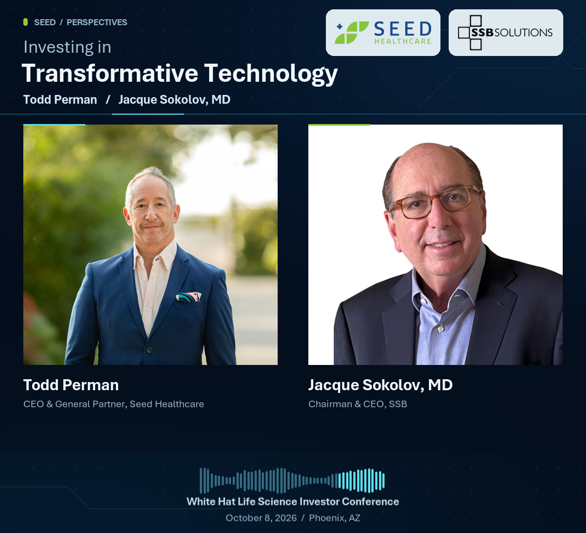
At the recent AZBio White Hat Life Science Investor Conference , Seed Healthcare CEO and GP Todd Perman and SSB Solutions Chairman and CEO Jacque Sokolov, MD discussed the opportunities and challenges of bringing transformative healthcare technologies into everyday clinical practice.
In this three-part series, we'll explore what their discussion means for healthcare providers, founders, and investors, from advancing early detection and prevention to navigating commercialization and building the right investment partnerships.
Beginning with a fundamental question: How can earlier information lead to better patient care?
Advances in diagnostics, imaging, and AI are creating opportunities to identify health risks before symptoms appear. For providers, this can mean more time to intervene. For founders and investors, it creates an opportunity to develop and support technologies that improve how care is delivered.
Identifying a risk, of course, is only the beginning. The real value comes from helping patients and clinicians understand the information and take appropriate action.
Give Patients a Clear Next Step
Consider a diagnostic test that identifies a potential health risk years before symptoms develop. Depending on the condition and available evidence, that information could help patients make lifestyle changes, pursue additional screening, or begin treatment earlier.
For healthcare providers, the challenge is translating that information into an appropriate care plan. Who reviews the results? What follow-up is recommended? What evidence supports intervention at this stage?
For founders developing these technologies, those questions should be addressed early in product development. Understanding the full patient journey helps determine where a product fits within clinical care and what resources are needed to support its adoption.
For investors, it also provides an important measure of a company's readiness. A compelling technology becomes a stronger investment opportunity when there is a clear, evidence-based path from detection to clinical action.
Make Prevention Practical for Providers
Even the most promising healthcare technology must fit into the realities of clinical practice.
Providers already operate within established systems for reviewing results, coordinating referrals, managing patient communication, and delivering follow-up care. Introducing new technology requires understanding those workflows and identifying where it can improve efficiency and outcomes.
During the White Hat discussion, Dr. Jacque Sokolov emphasized the challenge of changing established healthcare processes:
" And as most of you know, healthcare’s workflows are very much entrenched."
Jacque Sokolov, MD
▶ Watch Jacque discuss adoption and healthcare workflows (8:26)
For founders, this reinforces the importance of involving clinicians early in development. Their feedback can help identify operational barriers, clarify responsibilities, and shape technologies that complement existing care delivery.
For providers, successful adoption depends on having clear processes, manageable responsibilities, and tools that support rather than complicate patient care.
Todd explained why access and payment need to be considered together:
“If you can’t get a technology to the tipping point and in the hands of the clinicians, and then get it paid for, it’s a very hard road.”
Todd Perman
▶ Jump to clip: Todd on reaching clinicians and getting technology paid for (14:17)
For founders, that means working with clinicians early to understand how a product will fit into daily care. It also means identifying who will pay for it and what they need to see before supporting its use.
Bringing innovation to the point of care requires collaboration between the companies developing new solutions and the healthcare professionals who will ultimately use them. Engaging providers throughout development and commercialization helps ensure technologies address real clinical needs and can be implemented effectively.
Build a Sustainable Path to Payment
Clinical value is essential, but successful prevention technologies also need a viable financial model.
During the discussion, Todd highlighted the importance of getting innovative technologies into clinicians' hands while establishing a realistic path to payment.
A diagnostic tool may demonstrate significant clinical potential, but health systems, insurers, employers, and patients may evaluate its value differently. Each considers the evidence, potential outcomes, and financial implications of adoption.
For founders, this means identifying the likely payer, understanding reimbursement opportunities, and developing a commercial model that supports long-term adoption.
For providers, affordability and reimbursement can influence whether a technology is practical to offer and accessible to patients.
Investors must evaluate both sides of the equation. A technology's clinical promise needs to be supported by a credible commercialization strategy, including how it will be paid for and how it can scale.
The full cost of care also matters. An affordable initial screening may still create financial challenges if patients cannot access or pay for necessary follow-up appointments or treatments.
Planning for these realities early helps companies develop solutions that are both clinically meaningful and commercially sustainable.
Bringing Prevention Into Practice
The shift toward prevention presents an opportunity for healthcare providers, founders, and investors to work together to improve patient outcomes.
For healthcare providers, the priority is integrating earlier detection and preventive technologies into clinical workflows in ways that support better decision-making and patient care.
For founders, success requires looking beyond the technology itself. Clinical validation, provider engagement, patient experience, and a clear payment strategy all contribute to successful commercialization.
For investors, evaluating these factors helps distinguish promising innovations from companies positioned to achieve meaningful clinical adoption and sustainable growth.
At Seed Healthcare, this connection between innovation and implementation is central to the investment approach. By engaging healthcare providers and leveraging clinical relationships throughout the commercialization process, Seed works to help promising technologies reach the patients who can benefit from them.
Earlier detection creates an opportunity to change the course of care. Turning that opportunity into meaningful impact requires the right evidence, partnerships, and execution.
Coming Next in the Series
In Part 2, we'll explore the four critical factors that influence whether healthcare innovations succeed: clinical evidence, regulatory requirements, business models, and provider adoption.
Part 3 will examine what founders should look for in an investment partner and why commercialization support, clinical relationships, and strategic guidance can be just as important as capital.